
Why games matter for STEM learning
Education is moving away from rote memorization toward hands-on learning. Kids learn best when actively engaged, and games offer a highly engaging way to do this. Beyond making learning fun, games build critical thinking, problem-solving, and collaboration skills that textbooks often miss.
STEM skills are increasingly important for everyone, not just future scientists and engineers. These skills foster analytical thinking and innovation. You don't need a fancy lab or expensive equipment to start building them.
Board games effectively introduce STEM concepts to kids. They offer a safe space to experiment, make mistakes, and learn from them. Games allow repeated exploration of concepts, building understanding gradually. Friendly competition also motivates learning, proving that education can be enjoyable.
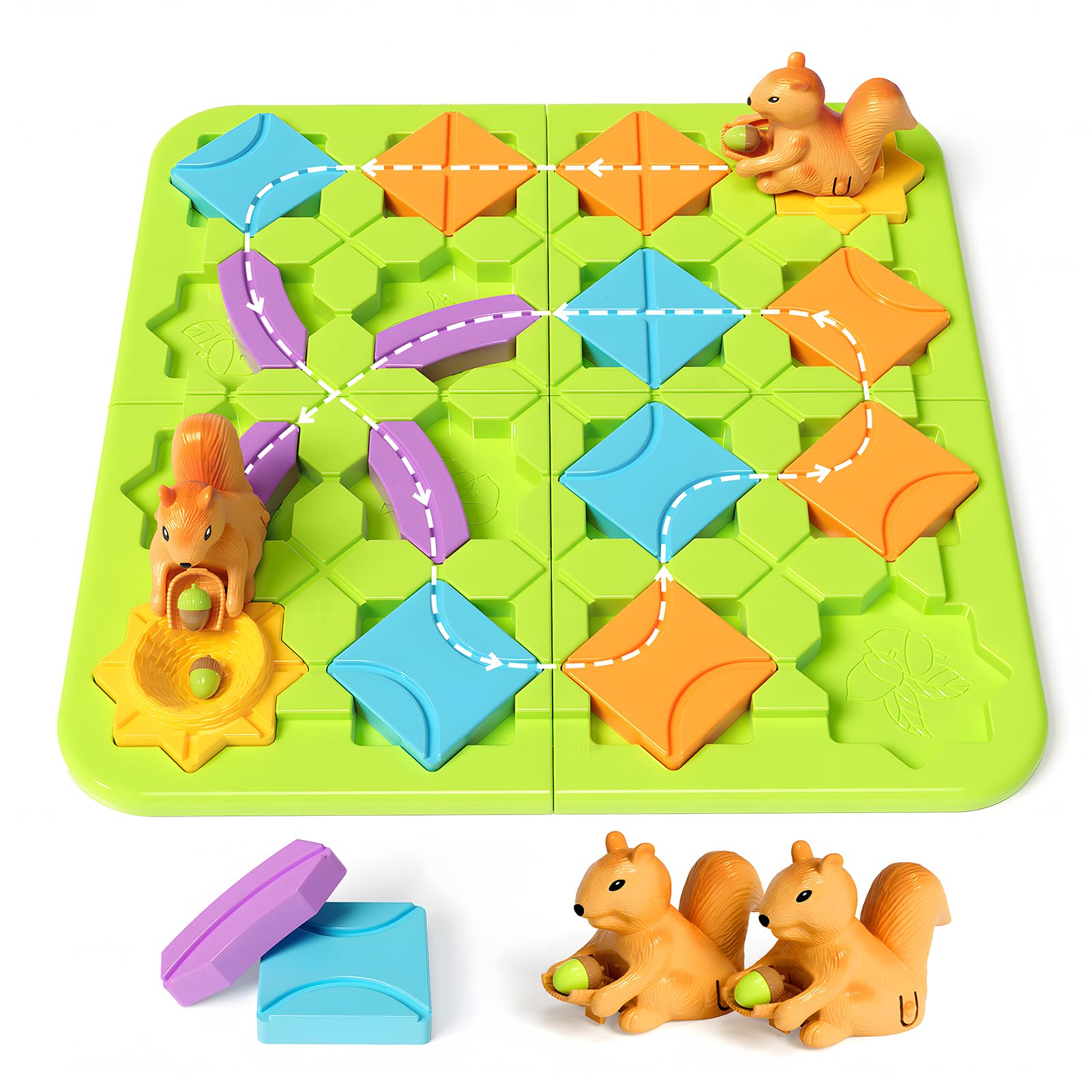
Fifteen STEM board games for kids
- Robot Turtles (ages 3-8): Introduces programming logic for young children. Players write instruction sequences to guide their turtle, learning fundamental coding concepts like sequencing and debugging.
- Prime Climb (ages 10+): A challenging game focused on number theory and arithmetic. Players use addition, subtraction, multiplication, and division to move pawns to the center of the board, reinforcing mathematical skills.
- Gravity Maze (ages 8+): A single-player logic puzzle challenging kids to build pathways using gravity. Players strategically place towers to guide a marble through obstacles, developing spatial reasoning and problem-solving skills.
- Code & Go Robot Mouse Activity Set (ages 4-9): Introduces coding fundamentals through a tangible, hands-on experience. Kids program a robotic mouse to navigate a maze, learning about sequencing, loops, and conditional statements.
- Rush Hour (ages 8+): A classic logic puzzle. Players slide cars and trucks around a grid to clear a path for the red car to escape, developing logical thinking, problem-solving, and spatial reasoning skills.
- Circuit Maze (ages 8+): Introduces electrical engineering concepts. Players build circuits using tokens to light up different parts of the board, learning about conductivity, circuits, and problem-solving.
- Math Dice Jr. (ages 6+): A fast-paced game reinforcing mental math skills. Players roll dice and use addition and subtraction to reach a target number, improving arithmetic fluency and quick thinking.
- Laser Maze (ages 8+): A single-player logic puzzle challenging players to redirect laser beams using mirrors and filters. It introduces optical physics concepts and spatial reasoning skills.
- ThinkFun Roller Coaster Challenge (ages 6+): Combines engineering and physics principles. Players build a roller coaster using tracks, learning about gravity, momentum, and structural integrity.
- Professor Noggin's Card Games (Various Ages): A series of card games covering science topics like dinosaurs and space exploration. These games use trivia and memory challenges to build knowledge.
- Photosynthesis (ages 8+): A strategy game about growing trees. Players collect sunlight to grow trees, strategically positioning them to maximize growth and earn points. It introduces concepts related to biology and resource management.
- Cytosis: A Cell Biology Game (ages 12+): Players take on the role of cellular components, working to build proteins and carry out essential cellular functions. It introduces cell biology.
- Terraforming Mars: Ares Expedition (ages 10+): Players cooperate to make Mars habitable. It introduces concepts related to climate science, resource management, and strategic planning.
- Subatomic: An Atom Building Game (ages 8+): Players compete to build atoms by collecting protons, neutrons, and electrons. This game teaches basic chemistry concepts.
- Ticket to Ride: First Journey (ages 6+): Introduces basic geography and route planning skills. Players collect train cards and claim railway routes, developing spatial reasoning and strategic thinking.
Featured Products

Combines the classic Hungry Hungry Hippos gameplay with Teenage Mutant Ninja Turtles characters. · Designed for 2 to 4 players, suitable for ages 4 and up. · An Amazon exclusive, making it a unique gift option.
This game offers a familiar and engaging way for young children to develop fine motor skills and quick reaction times, with a popular character theme to enhance enjoyment.

Explores multiplication, division, and prime numbers through colorful gameplay. · Features a unique color-mixing mechanic to solve mathematical challenges. · Designed to build number sense and mathematical fluency.
Prime Climb provides a visually appealing and deeply engaging approach to mastering fundamental math concepts, encouraging strategic thinking and number exploration.

A logic maze game where players build a path for a marble to reach its target. · Challenges players to think spatially and plan sequences of actions. · Includes 60 beginner to expert level challenges.
Gravity Maze is an excellent tool for developing critical thinking and spatial reasoning skills as children construct intricate marble runs to solve logic puzzles.

A screen-free robotics kit that introduces coding concepts. · Children program the mouse to navigate a maze and reach a target. · Includes coding cards and a maze for interactive play.
The Code & Go Robot Mouse Activity Set offers a hands-on introduction to programming and sequencing, fostering early STEM skills without the need for screens.

A sliding block puzzle that challenges players to navigate traffic jams. · Develops sequential reasoning, planning, and problem-solving abilities. · Includes 40 beginner to expert level challenges.
Rush Hour is a highly effective logic game that sharpens planning and sequential reasoning skills through a fun, traffic-themed challenge.
As an Amazon Associate I earn from qualifying purchases. Prices may vary.
Engineering and building games
Some games excel at fostering an engineering mindset. They require visualizing solutions, understanding structural integrity, and problem-solving when things don’t go according to plan. These games encourage creative thinking and approaching challenges from different angles.
ThinkFun Roller Coaster Challenge is a standout in this category. It’s not enough to just assemble the track; players need to consider gravity, momentum, and the weight distribution of the cars. Successfully building a functioning roller coaster is incredibly rewarding and reinforces fundamental engineering principles. The game’s difficulty levels allow for growth as skills improve.
Gravity Maze also deserves a mention. While it appears simple, the challenge lies in understanding how gravity affects the marble’s path. Players must carefully position the towers to create a stable and efficient pathway, developing spatial reasoning and problem-solving skills. It's a fantastic solo activity that encourages persistence and experimentation. Circuit Maze takes this a step further, introducing the basics of electrical engineering.
Coding concepts without a computer
These games introduce coding logic without a screen, which is valuable for younger children or those needing a break from digital devices. They demonstrate that coding involves logical thinking, sequencing, and problem-solving, not just writing lines of code.
Robot Turtles is a perfect starting point. The game teaches the fundamental concepts of programming – sequencing, debugging – in a very accessible way. Kids learn to write instructions to guide their turtle, understanding that even small errors can have big consequences. It’s a playful introduction to computational thinking.
Code & Go Robot Mouse Activity Set builds on these concepts, allowing kids to physically program a robot. This tangible experience helps them visualize the code and understand how it affects the robot’s behavior. It’s also a great way to introduce concepts like loops and conditional statements. Even Rush Hour, while not explicitly about coding, requires players to think algorithmically to solve the puzzle.
Making math skills fun
Math can be intimidating for some kids, but games can make it less daunting and more enjoyable. By integrating math into gameplay, these games subtly reinforce mathematical concepts rather than forcing rote memorization. The focus is on applying math skills in a meaningful context.
Prime Climb is a prime example – no pun intended. The game cleverly uses prime numbers and arithmetic to determine movement, making math an integral part of the strategy. Players naturally practice addition, subtraction, multiplication, and division without even realizing they’re "doing math."
Math Dice Jr. takes a more direct approach, focusing on mental math skills. The fast-paced gameplay encourages quick thinking and reinforces arithmetic fluency. It’s a great way to build confidence and improve calculation speed. Even Ticket to Ride: First Journey subtly reinforces math skills as players calculate route lengths and collect train cards.
Science exploration games
These games spark curiosity and encourage scientific thinking by introducing concepts from various disciplines. They show that science involves asking questions, making observations, and drawing conclusions, leaving kids wanting to learn more.
Photosynthesis is a beautiful example of a game that introduces biological concepts. Players learn about the process of photosynthesis, resource management, and the importance of strategic planning. The game’s artwork and components are also visually appealing, making it a pleasure to play.
Cytosis: A Cell Biology Game is a more complex option for older kids. It provides a surprisingly accurate and engaging introduction to cell biology, allowing players to explore the inner workings of a cell. Laser Maze offers a fantastic hands-on way to explore the principles of optics and light refraction. It's a challenging puzzle that requires spatial reasoning and problem-solving.
Adapting games for different learners
Every child learns differently, so what works for one may not work for another. Modify rules or provide extra support to make games more accessible. Simplifying rules, offering hints, or allowing collaborative play can help.
For kids who struggle with spatial reasoning, provide visual aids or break down tasks into smaller steps. For those easily frustrated, focus on the learning process, not the outcome. For competitive kids, encourage focus on personal progress over comparison. The goal is to foster a love of learning, not just winning.
No comments yet. Be the first to share your thoughts!