

STEM Play: Why Games Matter
STEM – science, technology, engineering, and mathematics – is crucial for preparing kids for the future, but it's more than just job training. STEM education cultivates critical thinking, problem-solving skills, and a lifelong love of learning. Board games are a great way to achieve this.
Games offer a unique environment for exploration and discovery. They encourage experimentation without the fear of failure, unlike traditional classroom settings. A child building a tower with blocks focuses on design and construction, not on getting a 'wrong' answer. This playful approach is effective, as studies show.
The MIT Education Arcade's work on learning games identifies opportunities and obstacles for wider adoption. A key challenge is designing games that are both engaging and educationally sound, as many games sacrifice one for the other. The best STEM board games balance genuine fun with valuable learning experiences.
Developing a STEM mindset early on equips children with skills to navigate a complex world, regardless of their chosen path. Analyzing, innovating, and collaborating are skills that translate across disciplines and are essential for success.
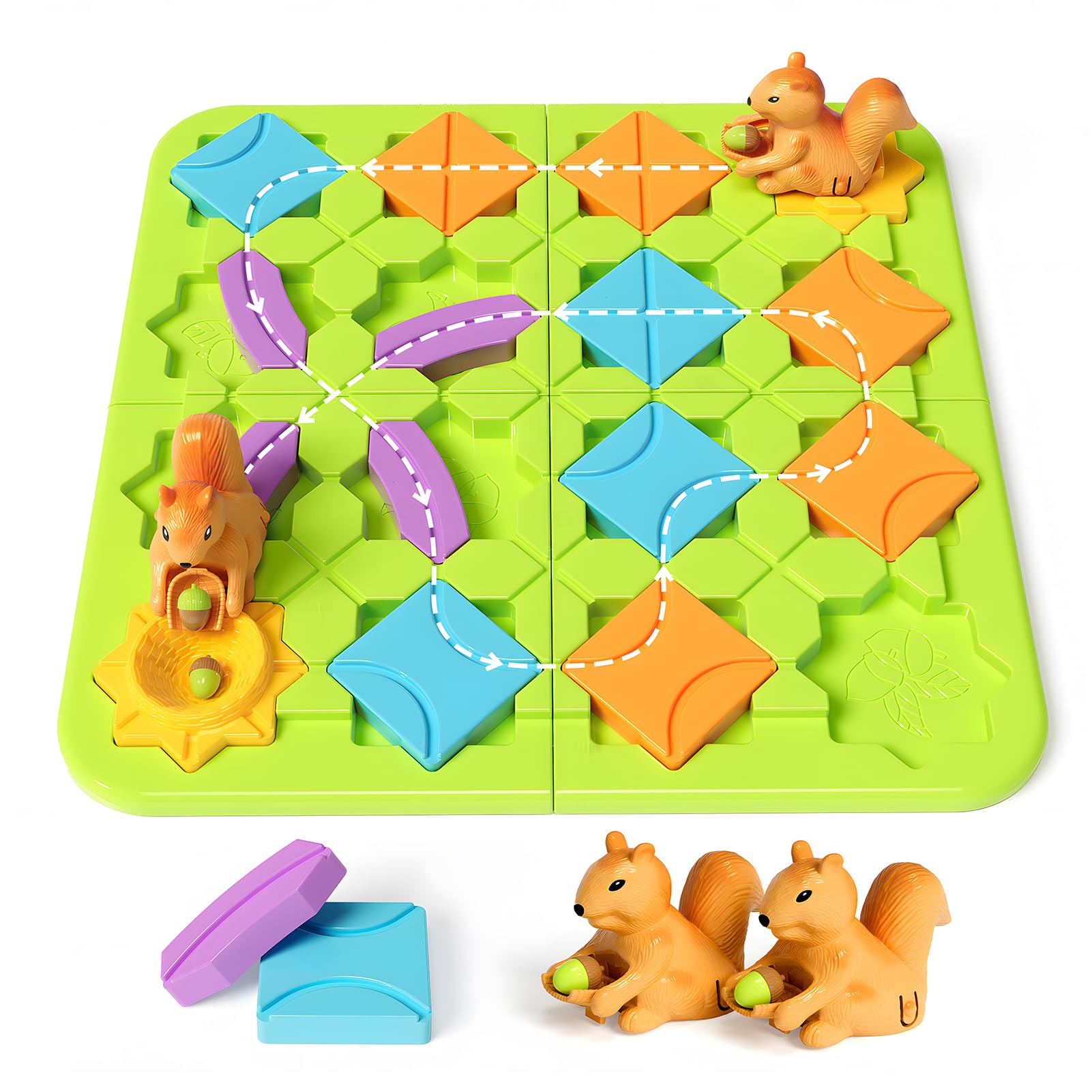
The Top 15 STEM Games for Kids (2026)
This list represents a careful selection of games based on educational value, engagement, and age appropriateness, with a range of price points and complexities to suit every family. The order isn't a strict ranking; different games will appeal to different children.
Robot Turtles (Ages 4+) is a fantastic introduction to programming fundamentals. Players write sequences of instructions to guide their turtle around the board. It’s a screen-free way to teach algorithms and logical thinking. Fun Factor: 4/5
Prime Climb (Ages 8+) brilliantly uses a colorful game board to teach number theory and mathematical operations. Players roll dice and use addition, subtraction, multiplication, and division to reach the center. It's surprisingly engaging, even for kids who struggle with math. Fun Factor: 4/5
Pandemic (Ages 8+) isn’t strictly a STEM game, but it promotes disease control and strategic thinking. Players work cooperatively to stop the spread of viruses, requiring planning, communication, and problem-solving. Fun Factor: 3/5
Gravity Maze (Ages 8+) challenges players to use logic and spatial reasoning to build pathways for a marble. It’s a single-player puzzle that’s both challenging and rewarding. Fun Factor: 4/5
Code & Go Robot Mouse Activity Set (Ages 5+) offers coding without screens. Kids program a robotic mouse to navigate a maze using coding cards. It’s a hands-on way to learn about sequencing and debugging. Fun Factor: 3/5
Evolution: Climate (Ages 12+) is a more complex game that explores adaptation and natural selection. Players evolve their species to survive changing environmental conditions. It’s a great way to introduce concepts in biology and ecology. Fun Factor: 3/5
SpaceTeam (Ages 12+) is a cooperative game where players must work together to repair a spaceship. It emphasizes communication and problem-solving under pressure. Fun Factor: 4/5
Circuit Maze (Ages 8+) introduces electrical engineering concepts in a playful way. Players build circuits to light up different pathways. It’s a hands-on way to learn about electricity and logic. Fun Factor: 4/5
Cytosis: A Cell Biology Game (Ages 12+) is a worker placement game that takes place inside a human cell. Players collect resources and perform cellular processes. It’s a fascinating way to learn about biology. Fun Factor: 4/5
Code Master (Ages 5+) is another excellent coding game for younger children. Players use logic and deduction to solve puzzles and guide a robot through a maze. Fun Factor: 3/5
Blockitecture (Ages 6+) focuses on spatial reasoning and engineering principles. Players build structures using uniquely shaped blocks. It’s a simple yet engaging game that encourages creativity. Fun Factor: 3/5
Equate (Ages 8+) is a math game that uses equations to earn gems. It reinforces arithmetic skills in a fun and competitive way. Fun Factor: 3/5
Photosynthesis (Ages 8+) teaches players about the life cycle of trees and the importance of sunlight. It's a strategic game with beautiful artwork. Fun Factor: 3/5
Laser Maze Jr. (Ages 6+) is a spatial reasoning game where players use mirrors and lasers to solve puzzles. It helps develop problem-solving skills. Fun Factor: 4/5
Rush Hour Jr. (Ages 5+) is a logic puzzle game where players must move cars and trucks to clear a path for the emergency vehicle. It’s a great way to develop critical thinking skills. Fun Factor: 3/5
Top 15 Educational STEM Board Games for Kids in 2026
Introduces programming concepts like functions and debugging · Cooperative gameplay encourages teamwork · No reading required, making it accessible for young children
Robot Turtles is an excellent introduction to computational thinking and logic, laying the groundwork for future technology exploration.
Teaches arithmetic, number sense, and algebraic thinking · Visually engaging with colorful pieces · Scalable difficulty for different age groups
Prime Climb makes mastering fundamental math skills fun and interactive, fostering a positive relationship with numbers.
Develops spatial reasoning and planning skills · Combines logic puzzles with a thrilling marble run · Includes 60 challenges ranging in difficulty
Gravity Maze challenges players to think critically about physics and engineering principles as they build pathways for the marbles.
Introduces coding and sequencing through hands-on play · Builds a maze and programs the mouse to reach the cheese · Encourages problem-solving and critical thinking
The Code & Go Robot Mouse provides a tangible way for children to learn the basics of coding and algorithmic thinking.
Cooperative gameplay teaches teamwork and strategy · Introduces concepts of disease spread and global health · Requires critical thinking and resource management
Pandemic offers a compelling challenge that teaches strategic planning and the interconnectedness of global systems, relevant to science and social studies.
As an Amazon Associate I earn from qualifying purchases. Prices may vary.
Coding Concepts Unboxed
Several games on this list introduce coding concepts without requiring a computer, allowing children to grasp programming logic tangibly. Robot Turtles and Code Master are particularly effective.
These games teach algorithms (step-by-step instructions for solving a problem) and sequencing (the order of instructions). They also introduce debugging, the process of identifying and fixing errors in code. These games can spark a child’s interest in computer science.
A 2019 study on serious educational games published in PMC.ncbi.nlm.nih.gov highlights the importance of engagement and relevance in learning. The research suggests games connecting to children’s interests and providing immediate feedback are most effective. Robot Turtles excels at this by framing coding as a fun, playful activity.
Complex coding concepts are broken down into smaller, manageable steps. These games present challenges appropriate for the child’s age and skill level, offering opportunities for experimentation and iteration, which are essential for learning.
Building & Engineering: Hands-On STEM
Building and construction games develop spatial reasoning, engineering principles, and problem-solving skills. Gravity Maze is a prime example, requiring players to think three-dimensionally and plan carefully to achieve their goal.
Blockitecture takes a different approach, encouraging creativity and experimentation with basic geometric shapes. It’s about understanding how different forms interact and how to create stable structures. These games aren’t just about following instructions; they’re about exploring possibilities.
These activities also develop fine motor skills, important for tasks from writing to using tools. Carefully placing blocks or connecting pieces requires precision and control. They help children understand fundamental physics concepts like balance and gravity.
Trial and error is central to these games. A tower might fall, a pathway might not work, but these failures are learning opportunities. Children analyze what went wrong and adjust their approach. This resilience is a valuable skill in any field.
Math & Logic: Beyond the Textbook
Math can be intimidating for some children. Games like Prime Climb and Equate offer a refreshing alternative to traditional textbooks and worksheets, making learning math fun and engaging while helping to overcome math anxiety.
Prime Climb cleverly introduces number theory and mathematical operations. The game’s mechanics naturally reinforce concepts like addition, subtraction, multiplication, and division. Both kids and adults can enjoy it.
These games encourage children to think critically and apply mathematical skills in a real-world context, moving beyond memorizing formulas to understanding underlying principles. Math is presented as a tool for solving problems, not just a set of abstract rules.
The competitive element in some of these games can be motivating, encouraging children to engage with a subject when challenged and rewarded for their efforts.
STEM Skills Challenge: Are You Ready to Build the Future?
Many of the fantastic STEM board games featured in our 'Top 15 Educational STEM Board Games for Kids in 2026' article help build essential math and logic skills. Let's test your own abilities with this quick quiz! These questions are similar to the types of thinking you'll use when playing games like Prime Climb, Robot Turtles, and Circuit Maze.
Science Explorers: Games for Budding Scientists
Sparking a child’s curiosity about science is a gift that lasts a lifetime. Games introduce scientific concepts accessibly and engagingly. Evolution: Climate, for example, simulates natural selection, allowing players to explore how species adapt to changing environments.
Cytosis: A Cell Biology Game takes a microscopic approach, immersing players in the world of cells and organelles. It’s a complex but rewarding game for learning about the inner workings of the human body. These games encourage experimentation and observation, not just presenting facts.
Even non-science-themed games can foster scientific thinking. Pandemic, for instance, requires players to analyze data, make predictions, and develop strategies to contain a disease outbreak, presenting a real-world problem in a game format.
The goal is to encourage children to ask questions, form hypotheses, and test ideas. Games provide a safe, stimulating environment for exploration, fostering a lifelong love of science.
STEM-Boosting Board Games
- Robot Turtles - Introduce young children (ages 4+) to the fundamentals of programming with this engaging game. Players use cards to guide their turtle around a board, learning sequencing and debugging concepts.
- Prime Climb - This colorful board game makes learning number theory fun! Players use addition, subtraction, multiplication, and division to reach the center of the board, reinforcing mathematical operations.
- Pandemic - A cooperative game where players work together as a team of specialists to prevent worldwide outbreaks of diseases. It promotes strategic thinking, planning, and understanding of disease control measures.
- Gravity Maze - Challenge spatial reasoning and physics concepts with Gravity Maze. Players build towers to create a path for a marble, learning about gravity and engineering principles.
- Code & Go Robot Mouse Activity Set - This screen-free coding activity allows children to learn the basics of coding by programming a robotic mouse to navigate a maze. It’s a great introduction to algorithms and problem-solving.
- Evolution: Climate - Explore the concepts of adaptation and natural selection in this strategic card game. Players adapt their species to a changing environment, learning about biodiversity and ecological challenges.
- SpaceTeam - A cooperative game that simulates a spaceship emergency. Players must communicate and follow instructions to repair the ship, promoting teamwork and problem-solving under pressure. It touches on basic engineering concepts.
- Circuit Maze - This logic puzzle game introduces electrical engineering concepts in a fun and accessible way. Players build circuits to light up different targets, learning about electricity and problem-solving.
Game Standouts: Worth a Closer Look
undefined blend of educational value and entertainment. Gravity Maze is one. It’s a deceptively simple game that provides hours of challenging fun. The puzzles are well-designed and progressively more difficult, keeping players engaged and motivated.
I've observed that kids often spend a long time working on a single Gravity Maze puzzle, demonstrating persistence and problem-solving skills. It’s a great solo activity, but it can also be enjoyed with friends or family. A potential drawback is that it can be frustrating for some children, so it’s best suited for those who enjoy a challenge.
Cytosis: A Cell Biology Game is another standout, but it’s definitely geared towards older children and teenagers. It’s a complex game with a lot of rules, but it’s incredibly rewarding for those who are interested in biology. It’s a unique way to learn about cellular processes and organelles.
Finally, Robot Turtles remains a top recommendation for younger children. It's a brilliant introduction to programming concepts, and it’s incredibly fun. The simplicity of the game is its strength. It’s easy to learn, but it provides a solid foundation for more advanced coding skills.
Choosing the Right Game: A Family Guide
Selecting the best STEM games for your children requires considering their age, interests, and learning styles. A game that’s too difficult or too boring will quickly lose their attention. Start with games that are appropriate for their developmental level and build from there.
It’s also important to play with your kids. This not only makes the experience more enjoyable but also allows you to provide guidance and support. Be patient and encouraging, and celebrate their successes. Remember, the goal is to foster a love of learning, not to turn them into experts overnight.
Be prepared for frustration. Some games are challenging, and it’s natural for children to get stuck or discouraged. Help them break down the problem into smaller steps and encourage them to persevere. And don’t be afraid to modify the rules or offer hints if needed.
Ultimately, the best STEM games are those that spark curiosity, encourage creativity, and make learning fun. By choosing the right games and creating a positive learning environment, you can help your children develop the skills they’ll need to thrive in the 21st century.
No comments yet. Be the first to share your thoughts!